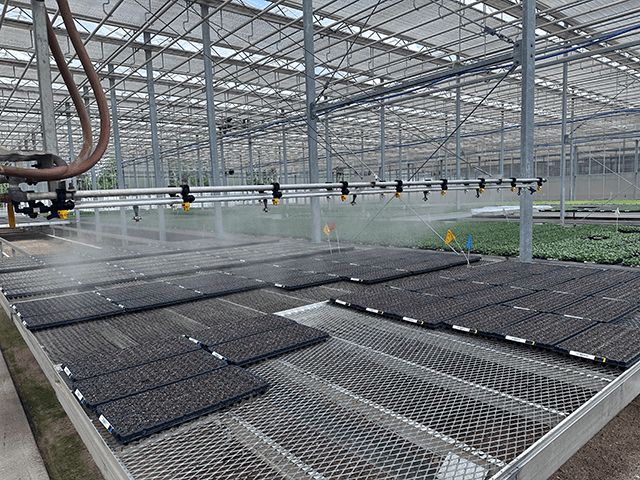

Table of Contents
Successful propagation requires a careful balance of water and humidity. Unrooted cuttings need high humidity to limit water loss through their leaves, but applying too much water can saturate the growing media and create an entirely different set of problems.
The challenge for growers is simple: how do you keep a cutting hydrated without keeping the media too wet?
Managing Water Loss During Propagation
When a cutting is first stuck, it has leaves that continue to lose water through transpiration but little or no root system to replace that water. Until roots develop, the propagation environment must help reduce this water loss.
Mist is commonly used to accomplish this. Increasing humidity around the leaves reduces transpiration, while evaporation of water from the foliage and surrounding air can help cool the plant.
But there is a difference between providing humidity and simply applying more water.
Too much mist can saturate the growing media, reducing the amount of oxygen available in the root zone. Constantly wet conditions can also encourage algae, fungus gnats and diseases such as Botrytis. The goal is to maintain sufficient moisture around the cutting while avoiding unnecessary water in the media.
Droplet size plays an important role in achieving that balance.
Droplet Size Matters
Greenhouse mist is generally considered to have a droplet size between approximately 50 and 100 microns. Smaller droplets have a greater surface area relative to their volume and can evaporate more readily than the larger droplets normally associated with irrigation.
This makes fine mist useful when the objective is to increase humidity or provide evaporative cooling rather than deliver significant amounts of water to the growing media.
The amount of mist required will change throughout the propagation cycle. Newly stuck cuttings generally require more frequent mist because they have little ability to replace water lost through transpiration. As roots develop, the plant becomes increasingly capable of taking up water from the media and mist frequency can be reduced.
Light, temperature and humidity also affect the amount of mist required. A warm, sunny day may require considerably more mist than a cool, cloudy day. Ideally, mist should respond to the needs of the crop and greenhouse environment rather than simply operating at the same frequency throughout the day.
Separating Mist from Irrigation
Irrigation booms provide growers with an efficient and uniform method of watering crops. During propagation, however, the nozzles used to irrigate the growing media may apply more water than is necessary when the primary objective is increasing humidity around the foliage.
Adding a separate mist application to the boom allows these two functions to be managed independently.
Dramm's JetFog Boom Kit is designed to add a row of JetFog nozzles to an existing irrigation boom. The JetFog produces an average 80-micron droplet at 50-70 psi, with each nozzle tip applying just 1.5 gallons per hour (5.8 liters per hour).
The smaller droplets and low flow allow the boom to provide fine mist for humidity and cooling without applying the volume of water associated with normal irrigation.
When the growing media needs water, the boom's irrigation nozzles can be used. When the crop primarily needs humidity or cooling, the JetFog nozzles can provide a much finer application.
Using the Boom You Already Have
Adding mist to the irrigation boom also takes advantage of equipment already traveling over the crop.
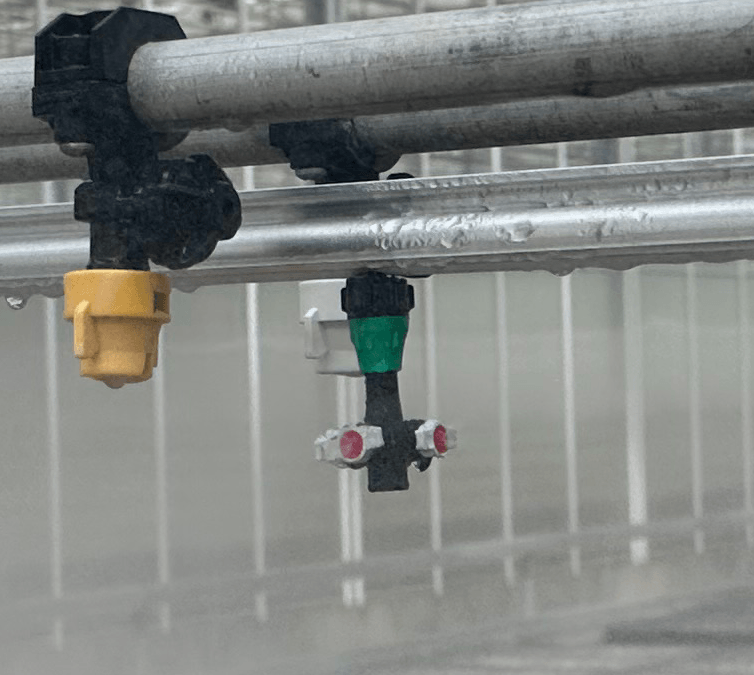 JetFog Nozzle in PolyRail on Irrigation Boom
Instead of installing a separate stationary mist system, the JetFog Boom Kit mounts directly to the existing boom. The kit includes JetFog nozzles, PolyRail to support the nozzles, PE tubing and the fittings needed to connect the system.
As the boom travels through the propagation area, the JetFog nozzles move over the crop with it, providing fine mist across the growing area.
This gives growers another tool for managing the changing needs of a propagation crop without adding another overhead irrigation system.
The Right Amount of Water in the Right Place
Good propagation is not simply about keeping plants wet. It is about managing the environment around the cutting while maintaining appropriate moisture and oxygen in the rooting media.
Fine mist can help growers maintain humidity and reduce plant water loss without continually adding large amounts of water to the media.
By adding JetFog nozzles to an existing irrigation boom, growers can use one machine for two different jobs: irrigating the growing media when water is needed and providing fine mist when the crop needs humidity.
That additional level of control can make maintaining the delicate balance required during propagation considerably easier.
FAQs
Why is fine mist beneficial during propagation?
Fine mist helps maintain high humidity around unrooted cuttings, reducing water loss through transpiration. This helps keep cuttings hydrated while their root systems develop without adding excessive water to the growing media.
What is the difference between propagation mist and regular irrigation?
Regular irrigation is intended to deliver water to the growing media and root zone. Propagation mist uses much smaller droplets and lower water volumes to increase humidity, cool foliage and reduce moisture loss from cuttings. Keeping these functions separate can help prevent overly wet growing media.
Can the Dramm JetFog Boom Kit be added to an existing irrigation boom?
Yes. The JetFog Boom Kit is designed to add fine-mist capability to an existing irrigation boom. It uses JetFog nozzles that produce an average 80-micron droplet, allowing growers to use the same boom for normal irrigation and fine mist applications.