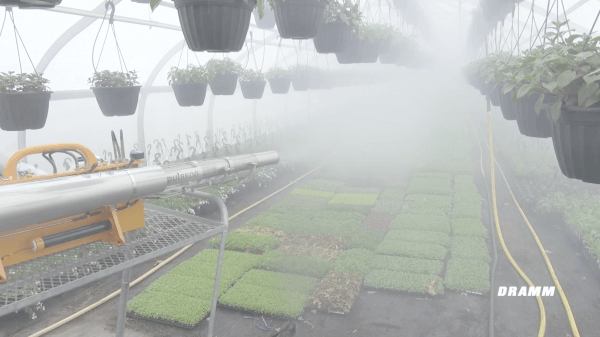
Fogging for plant protection involves much more than creating a fog. Recent equipment releases into the horticultural industry show videos of fog permeating a crop and rapidly obscuring the space with a thick, smoke-like fog that cannot be seen through.  Systems like this are most commonly used in the filmmaking industry where battlefields are often made to look more realistic with plumes of "smoke" and the fog of war. Unfortunately, these fogging systems rely on two points that make them less useful for plant protection.
First, these systems work by heating the solution to the point of vaporization. This means that the solution is almost becoming a gas rather than a fog. This creates a very small droplet very quickly. However, this presents a problem because of the different chemistries used for plant protection as well as the crops themselves. For this to work, the chemicals must be oil-based. Granular, soluble and wettable powders won't work with this because they would all precipitate out of solution on the heating surface inside of the machine.
The second issue with these newer systems is that they rely on oil formulations. These are not oils that mix with water, as is common in plant protection. These are oil carriers with oil-based pesticides. The reason for this is clear, oil fogs easier than water. This is primarily due to the fact that oils have very little surface tension and can be broken into very small droplets as a result. Water, with stronger surface tension, often requires modification through the use of surfactants to improve fogability. Dramm equipment can fog oils beautifully with similar results as these new systems.
Another reason these systems appear to fog better is the speed of output. The PulsFOG creates a similar effect, also due to speed. However, the Dramm Autofog creates a very effective fog, but over a much greater time using aerosol generation instead of thermo-kinetic nebulization. As a result, the fog is no where near as visible. However, it is very effective for applying pesticides.
Unfortunately, while oils fog easier, the plant protection chemistries available in the horticultural industry are all water-based. To be effective as a pest control tool for plant protection, fogging equipment must be able to also fog water-based solutions. Dramm equipment has all been designed to apply water-based horticultural products. The efficacy of these systems is not based on visibility of the fog, it is based on the ability of the fog to effectively distribute a pesticide throughout the crop to eliminate pests. Dramm equipment has decades of application success in greenhouses and indoor facilities.
The visual demonstrations that oil-based foggers rely on is not practical for plant protection. While products like the Autofog and even the PulsFOG do not create as visible of a fog when used with water-based products, they do produce a fog that is effective at applying a wide range of pesticides to indoor crops.